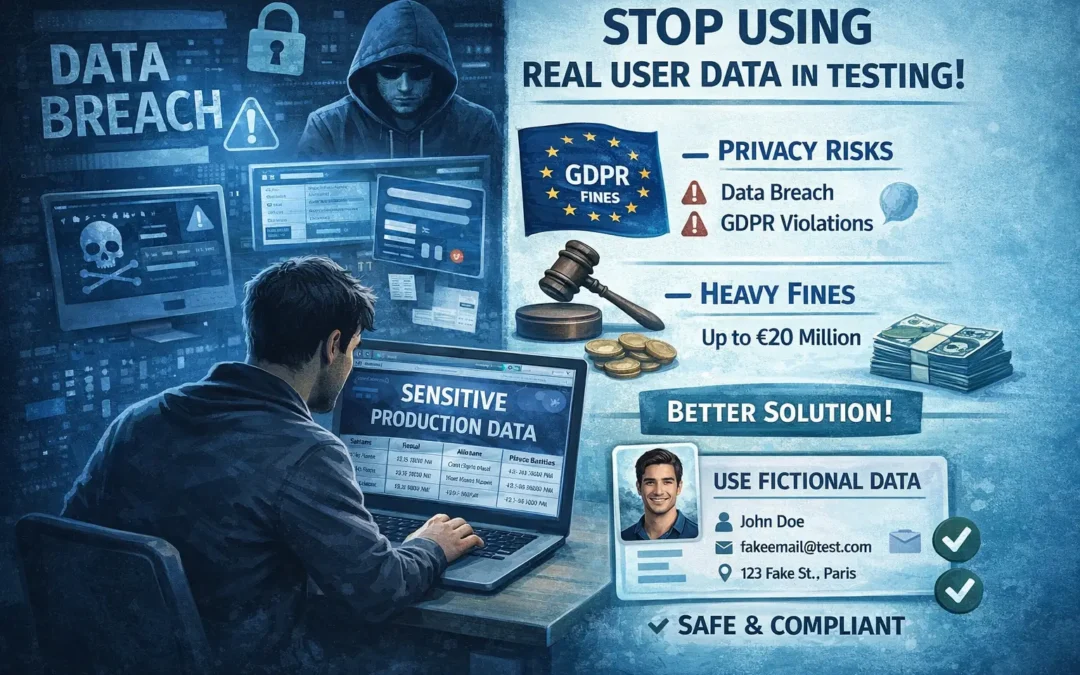
It happens in almost every development team at some point. A developer needs realistic data to test a new feature, and the quickest solution seems obvious: pull a sample from the production database. Real names, real emails, real addresses — it looks authentic because it is. The tests pass, the feature ships, and nobody thinks twice about it.
Until something goes wrong.
Using real user data in development and testing environments is one of the most common — and most underestimated — privacy risks in software development. Here's why it matters, what the law says about it, and what you should use instead.
What GDPR Actually Says About Test Data
The General Data Protection Regulation (GDPR), which applies to any organization handling the data of EU residents, is explicit on this point. Personal data must be collected for specified, explicit, and legitimate purposes — and used only in ways compatible with those purposes. Testing a new feature is not why your users gave you their data.
Beyond the purpose limitation principle, GDPR also requires that personal data be protected with appropriate technical and organizational measures. Development and staging environments are, by nature, less secure than production. They're accessed by more people, often have weaker access controls, and are sometimes shared with third-party contractors or agencies. Putting real user data into these environments significantly increases the attack surface for a potential breach.
The consequences of getting this wrong are serious. GDPR fines can reach up to 4% of annual global turnover or €20 million, whichever is higher. But beyond the financial risk, a data breach involving a development environment is the kind of incident that destroys user trust permanently.
The Problem With "Anonymized" Production Data
A common middle-ground approach is to anonymize production data before using it in testing — replacing real names and emails with scrambled versions. In theory, this sounds reasonable. In practice, it's much harder to do correctly than most teams assume.
True anonymization means the data cannot be re-identified under any circumstances — not by combining it with other datasets, not by cross-referencing behavioral patterns, not by any reasonably likely means. Pseudonymization, which is what most quick anonymization scripts actually produce, still counts as personal data under GDPR because re-identification remains possible.
Doing anonymization properly requires significant technical effort, regular auditing, and ongoing maintenance as your data structure evolves. For most teams, it's more work than it's worth — especially when a better alternative exists.
The Better Approach: Synthetic and Fictional Data
The cleanest solution is to never use real personal data in testing environments in the first place. Instead, generate fictional data that is realistic enough to serve all your testing needs without carrying any of the legal or ethical risk.
This is exactly what a tool like ProntoPersona is designed for. Every profile it generates — name, address, email, phone number, and AI-generated photo — is entirely fictional. There is no real person behind any of it. You get all the realism you need for meaningful tests, with zero privacy liability.
For individual test cases, you can generate profiles one at a time and copy the fields you need directly. For larger datasets, you can generate multiple profiles in quick succession and compile them into a seed file. Either way, the process is faster and safer than working with production data.
Beyond Compliance: It's Just Good Practice
It's worth stepping back from the legal framing for a moment. Even if GDPR didn't exist, using fictional data in development environments would still be the right approach — for practical reasons that have nothing to do with regulation.
Real user data in a development environment means that every developer on your team, every contractor you bring in, and every staging server you spin up has access to information your users trusted you to protect. That's a responsibility worth taking seriously, independent of any legal requirement.
Building a culture where fictional test data is the default — not the exception — is a sign of a mature, privacy-conscious development team. It's the kind of practice that doesn't make headlines when it goes right, but absolutely makes headlines when it goes wrong.
A Simple Rule for Your Team
If you're looking for a practical policy to adopt, this one is hard to argue with: no real personal data outside of production, ever. For any situation where you need user-like data — testing, demos, tutorials, development — use a fictional profile generator instead.
It takes less time than pulling from production, it requires no anonymization effort, and it eliminates an entire category of compliance risk. For something that costs nothing and takes seconds, it's one of the highest-value habits a development team can build.